Showing posts with label rant. Show all posts

Tuesday, July 27, 2021

$#!+ house

"The dining room, deep in the hotel, is a broad space of high ceilings and coving, with thick carpets to muffle the screams. It is decorated in various shades of taupe, biscuit and fuck you."


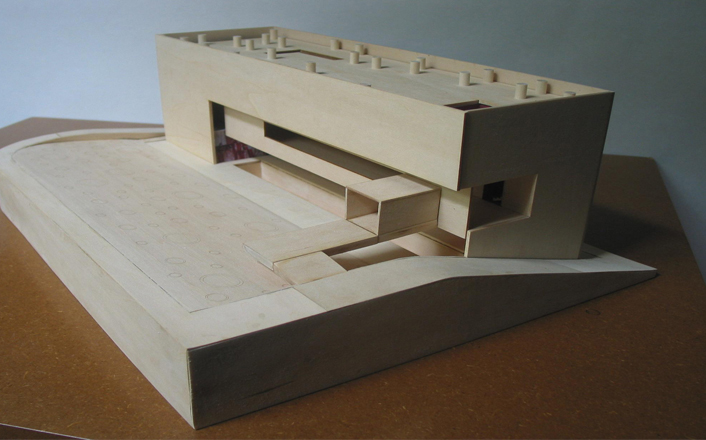
Someone will ask me of the hypothetical house I designed for myself, “why do I have a slide going down from my loft sleeping space? why not just the stair?” To this hypothetical question, I would not just simply answer “why not?” as if to say “all the other possible, typical, or predictable options were considered and this was just the most practical solution from that space to go down in elevation”; or “that its novelty was too good to pass up”. For me, “I like slides. I just wanted one” would suffice as an answer.
 
I’m not sure that’s a good answer, but I don’t think it’s a wrong answer. Saying that “a slide is a playful way to go down” could be said, written off as just a shortcut for thinking how to design a playful way to traverse downward, that I could have done that with a playful stair; or that I haven’t gone far enough, that I could have had a fireman’s pole, or a crash pad, or a zip-line. Or that it’s not even interesting: “I mean, have you googled ‘houses with slides’?” I could also be accused of not being serious, or real architect because I can’t be taken seriously as an architect for designing a slide in my house. Or that it’s tasteless or dumb or lazy or shit design or whatever other countless criticisms. 

Somewhere in this point I think of what is everyone’s favorite color or what percentage of people prefer to sleep naked versus clothed, or if they like cilantro, and of the countless of things dictated by personal preference that go beyond taste or style or expectations of the norm. I think of our collective average screen-time calculated by our phones (4.2 hrs) or how 38 percent of video game players are between the 18 to 34 age, and as society we can say ‘that’s good’ or ‘that’s not good’ but we can’t deny that that is in fact the “new normal”, which may even lead into some digression about ‘what is normal? vis-a-vis what is deviant or unexpected? But also, that could be just dodging the question, and I don’t know if that’s even relevant to the initial question. The answer ‘why do you care?’ just seems rude and unnecessarily confrontational. But sometimes a middle finger is a too good as an answer as any. 

“Enjoy your slide.”

“Thanks.”

FOG Throwing Shade Throw, Andy & Dave

Tuesday, January 6, 2015

let's f**k shit up

and start posting again.

Thursday, October 6, 2011

untitled

“In the 1960s, Robert Venturi and I played a game we called "I can like something worse than you can like." Creativity can't happen without fun, but our serious purpose was to open our eyes by assaulting them.”
- Denise Scott-Brown, "Questions of Style" in Artforum 

It usually takes a good provocation to inspire a decent burning missive. Thank goodness for another discussion about post-modernism! But what about tomorrow? Will there be a follow-up movement naming, or must we take the effort upon ourselves?

Tuesday, June 29, 2010

moving targets

While this blog can be seen simply as reblogging, promoting or condoning silently “things we like”, or even worse, as pseudo-academic intellectual posturing, to conceal our own theoretical inadequacies about the subjects raised while lacking the capacity to give meaningful answers, it is hard to refute since we do not present a position on all of the things we post. Conclusions can be made by what is posted versus what is not, whether implicit or intended. In fact, it’s even harder to say this blog productive at all! (Hence the hyperbolic superlative...)

“Architecture is frozen ideology.”
- Slavoj Žižek

One can imagine, as a mental experiment in Bartlebian politics, in where doing nothing, or the lack of action, is the most violent thing to do (Žižek, 214); you can say this is limited to (political) actions, such as silent protests or abstaining to vote, but what is not to say that ignorance or lacking of knowing or saying also carries meaning, and inherently a position. In this sense, everyone has a position, whether they say it or not.

To elaborate, Fredric Jameson in The Political Unconscious frames aesthetic action as never being without implicit meaning, which can even be contradictory to its explicit meaning (Žižek, Architectural Parallax). The idea that an artist’s aesthetic actions are never merely aesthetic and are guided by an unconscious framework can be recast to not be limited to only artists and artistic actions (or architects and architectural acts): every action is loaded with meaning, implicit or explicit. This is also to say, for something to have meaning, it has to have weight and consequence within a system or framework, and ultimately within an ideology.
Jameson is fully justified to talk about the “political unconscious”: there is a coded message in an architectural formal play, and the message delivered by a building often functions as the “return of the repressed” of the official ideology. Recall Wittgenstein motto: what we cannot directly talk about, it can be shown by the form of our activity. What the official ideology cannot openly talk about can be shown by the mute signs of a building.

overcoming (post-)modernity

It is probably fair to pick on Patrik Schumacher’s The Parametricist Epoch: Let the Style Wars Begin and Parametricism as Style - Parametricist Manifesto, if not for the sole fact that his manifesto reads like a declaration from the Borg. He does further discuss the environment and urbanism elsewhere (Ma Yansong, 202-208), but there is a lot he doesn’t say, and leaves to suggest parametricism can readily assimilate any issue or agenda as a variable.

In a similar tone a hundred years ago, Sant’Elia and Marinetti’s “Futurist Architecture” vehemently attacks the state of architecture at the turn of the century that follows the grand narrative of history, which employs conventional forms and theories in a temporal context that’s far more technologically advanced than the traditional precedents.

You don’t have to go through the last hundred years of architecture manifestos (Ulrich Conrads, ed. Programs and Manifestoes on 20th-Century Architecture) to recognize that not one of them is perfect. This is not to be apologetic or even simplistic about something that is more politically complex and nuanced, or an attack on the style of the “Architectural Digerati”.

It is more about the provocation in his comments: rather than about being (or being afraid of being) modern (or post-modern or contemporary), “Do you have convictions… Are you able and willing to state the principles that underly [sic] your work?”

It is a risk, a compromise to the identity of one’s beliefs, ideas, and/or position, an invitation to criticism and scrutiny. Why (not) join (or hide) in the hegemony, the opinion leaders and architect celebrities?

lines drawn

Not to insinuate that Ayn Rand (The Fountainhead) was right (with her avocation of the enlightened egoist or her slam on the collective conformists), but to not be polemic is a deferral of responsibility for your own beliefs. Pluralism does not cause this: pluralism is the result. In the Architectural Parallax, Žižek portrays what this ideological indifference, “apoliticality” means, with the example of the Muscovite nouveau-riche, living in new-built neo-Stalinist neo-Gothic Baroque postmodern pastiche apartment blocks:
The “spontaneous ideology” of this new bourgeoisie is paradoxically what appears as the opposite of their vulgar “passion of the real” (pleasures, money, power), a (no less vulgar) pan-aestheticism: all ideologies are equal, equally ridiculous, they are useful only to provide the spice of aesthetic excitement, so the more problematic they are, the more excitement they generate. The neo-Stalinist architecture pretends to pretend – it (and its public) think they just play a game, and what they are unaware of is that, independently of their playful attitude, the game has the potential to get serious. Their “playful indifference” conceals the reality of the ruthless exercise of power: what they stage as aesthetic spectacle is reality for the masses of ordinary people. Their indifference towards ideology is the very form of their complicity with the ruling ideology.
Though this may be an absurd logical extreme, this expert poses that more is at stake than style; Schumacher claims as much as well, stating as style is not “merely a matter of appearance”, that “a new style in architecture and design is akin to a new paradigm in science”. If style indeed has such weight, then all edifices have their ideological, political ramifications and social antagonisms (Žižek, Architectural Parallax, again), even if style is repudiated.

Patrik Schumacher's polemic inadvertently suggests a different mantra than parametricism: make your own personal (architectural) version of E.M. Forester’s “What I Believe”, have convictions, even if they change over time. Go ahead: take a position, you polemicist!

references: 
Patrik Schumacher - Patrik Schumacher on parametricism - 'Let the style wars begin', The Architect’s Journal
Slavoj Žižek - Architectural Parallax: Spandrels and Other Phenomena of Class Struggle
Slavoj Žižek – Violence (New York: Picador, 2008)
Robin Pogrebin - I’m the Designer. My Client’s the Autocrat, NYTimes
F.T. Marinetti - The Founding and Manifesto of Futurism
Javier Arbona - Pa(rame)trik Schumacher Responds, archinect
Ian Martin - It’s time for architects to roll up their sleeves, and their trouser legs, The Architect’s Journal
Régine Debatty - Book Review: Digital Architecture - Passages Through Hinterlands, we make money not art
Ma Yansong - Mad Dinner: A Monograph on the Beijing-Based MAD Office (New York: Actar, 2007)

Tuesday, April 27, 2010

on cynicism

Peter Sloterdijk is a current-favorite current philosopher, cited often in architecture academia. He teaches philosophy and aesthetics at the State Academy of Design at the Center for Art and Media in Karlsruhe, and is a professor at the Academy of Fine Arts in Vienna. He is most famous for his book, Critique of Cynical Reason, made first available to the English-speaking world in 1988, and his latest work, Sphären Trilogy, currently is being translated. He has his own show in Germany for which he is a co-host on to wax philosophy and contemporary issues, and he partakes in lectures, panels, and seminars world-wide, for which according to his website, he is normally booked for one or two years in advance.   

Ordos 100, master plan by Fake Design 

architect as cynic 

To jump cut, shown here is a photograph from part two of a conference, showing design pitches for Ordos 100, a huge upscale residential project in the desert of Inner Mongolia, China, where one hundred mostly up-and-coming architect teams from twenty-seven countries were commissioned to each design a individual house, large enough to include amenities such as servants’ quarters and indoor pools, as part of a billion-dollar “cultural district”. Ordos 100 was conceived by Cai Jiang, who got his start trading cashmere and freshwater pearls to Russians for recycled steel and has since diversified into a dozen businesses, and made his money in coal and dairy and has lately turned to real estate. Ai Weiwei, a Chinese artist, and his firm, FAKE, were commissioned as the master planners. Weiwei is known for using his art to make critical remarks on the current regime in China, and is an all-around provocateur. 

This project was profiled in the New York Times last year in May.  

Besides the quotes by the architects, who were lamenting about the shitty nature of the current architecture industry and were blind-slightly thrilled just to be building something and making stupid comments like ‘we got a little taste of what it’s like to be Zaha Hadid’, this is one of the few that was sober, self-reflective, and almost cheeky, and to quote: 

“Are we just performers in another of Weiwei’s pieces?” 

The last quote’s skeptical and cynical position summates our current condition; not just as an architect who has been flown to the middle of no-where to build a too-good-to-be-true architectural object among many in a Disney-world of an American-esque suburb out in the Mongolian desert, but of our Western social culture of cynicism as the reflexive default attitude.   


“new values? no thanks!” 

The modern cynic, whatever her situation or as ridiculous as it is, has to go forward and move on, a conscious moving on, in spite of anything that might happen, and especially after anything that might happen. She must carry a certain chic bitterness about her activity.  
For cynics are not dumb, and they every now and then see the nothingness to which everything leads. Their psychic apparatus has become elastic enough to incorporate as a survival factor a permanent doubt about their own activities. They know what they are doing, but they do it because, in the short run, the force of circumstances and the instinct for self-preservation are speaking the same-language, and they are telling them that it has to be so. Others would do it worse. (5) 
Sloterdijk clearly defines cynicism is enlightened false consciousness. A cynic is someone whose social existence and values she can no longer see as necessary and universal, and who is miserable because of this understanding - because she sticks to principles that she does not believe in. The only truth left for a cynic is her trust in reason, which however cannot provide her with a firm basis for action, and this again is another reason for her misery. 

The cynic is someone who is well-entrenched in the cogs her society, so to speak in bastardized Marxist sort of way, of someone neck-deep in ideology or a profession, who does not believe in what she is doing anymore, like a priest who doesn’t believe in God, but still preaches on as if she still believes in the dogma, which again, makes her miserable and leads her to this schizoid frame of mind. To quote Sloterdijk again: “it is the universally widespread way in which enlightened people see to it that they are not taken for suckers.” (5) 

The problem with the cynic is that she has already given up. She has come to accept the terms of her conditions and does nothing about it other than sneer.

But Sloterdijk doesn’t say that a cynical view is the way to go, that this nihilist approach is just a knee-jerk reaction. (6) For this Sloterdijk goes back to the classical association of cynicism to kynicism of Diogenes, or cheekiness. Diogenes lived in a barrel, shown contempt for fame, ridiculed the architecture, refused respect, walked through the streets carrying a lamp in the daytime looking for one honest man, parodied the stories of gods and heroes, ate raw meat and vegetables, fooled around with the whores and when lounging said to Alexander the Great that he should get out of his sun.

What this is, is a rejection of the hegemony of mainstream thought; for Diogenes this was idealism. He made acting the truth into a process of confronting the prevailing lies of the current ideologues, as a resistance to the rigged game of discourse, philosophical or otherwise. He used the basest of actions, of physical reality, to counter the typical dialectic, the abstractions and satirical remarks.

If the modern cynic has at least the satisfaction of being right most of the time and pleasantly surprised the rest of the time, then cynics would be nothing if not perpetually satisfied. Cynicism does not have to be the default status; and cheekiness isn’t limited to the Athenian market. Cheekiness has a space in which it can be tolerated, even if that tolerance lasts only a short time. (117) Cheekiness is not the final answer, but can at least be a temporary solution and a way out of the problem of the untempered cynicism of the current M.O.

references:
Peter Sloterdijk, Critique of Cynical Reason (Minneapolis: University of Minnesota Press, 1987)
“The Twilight of False Consciousness” 3-9; “Search of Lost Cheekiness,” 101-120; “The Secondary Cynicisms: Minima Amoralia: Confession, Joke, Crime,” 301-307.
Peter Sloterdijk - website
Fred A. Bernstein - In Inner Mongolia, Pushing Architecture’s Outer Limits, NYTimes
Lebbeus Woods – O, Ordos
Archilosophy – Ordos 100
Al Jazeera - China's empty city (YouTube)
Stefan Lorenz Sorgner - In Search of Lost Cheekiness, An Introduction to Peter Sloterdijk’s “Critique of Cynical Reason”

Friday, April 16, 2010

our manifesto

You may be wondering: just what is the criteria for what gets posted on super_productive?

We here at super_productive pride ourselves on our most-de rigueur screening process:

to constantly probe the internets or the world at large for super-productive work produced of our near or immediate contemporaneity, and then with a critical lens - examine it with a simple question:

“is it super-productivesque?”

Indeed, it is a grueling and selective process that allows only for the best of pop architecture, art, and etcetera to be featured here everyday for your viewing pleasure.

While other blogs/cults of personality are seeped in self-promotion, self-reference and self-aggrandizement, we here at super_productive strive to be the absolute shit.

Friday, February 19, 2010

hipster architecture

“Culture appears to come from nowhere and to be heading nowhere.”
- Ben Agger, “The Thesis of the Culture Industry”

Hipsters… Hipsters are a subculture of “cool” youth, with a taste for the cultural non-mainstream. ‘Hipsterism’ is the catch-all term used to describe the specifics of its lifestyle and culture, specifically of the hipsters of recent. In short, hipsterism is “fashionable nihilism”. It is culture without meaning or authenticity.

The following is an unofficial, incomplete, and unreliable manifesto for ‘hipster architecture’, if there ever can be such a thing. ‘Hipster architecture’ for the sake of argument becomes a catch-all for contemporary architecture. It is an unapologetic comparison/criticism of contemporary architecture through the lens of hipsterism, and probably guilty of being as unproductive as hipsterism itself. It fails to define specifics and evade further, in-depth explanation. It assumes everything and takes responsibility for nothing. It is already late to the scene. You either get it or you don’t.

if you don’t give a damn, we don’t give a fuck

Hipster architecture, rooted in cynicism and apathy, prefers a relativist, apolitical ground (Zaera-Polo, “Politics of the Envelope”); more specifically, it is an architecture devoid of ideology, that throws a bone to politics through its effects (peripheral: skins, façades; experiential: atmospheres, environments). In reality, hipster architecture is relieving itself of political responsibility, allowing it to do what it pleases for whomever it wants, relative to the client’s own whims (surfing).

fetish, fashion, kitsch, camp

Hipster architecture is not a trend, but trendy. Hipster architecture cannot be nailed down. What is definitive is if the “cool/new thing” in hipster architecture gets too popular, it gets abandoned for the next cool/new thing (Moussavi’s Function of Ornament → Function of Form). Calling it “camp” would be giving it too much credit (Sontag, “Notes on “Camp””).

Not there yet. (Koolhaas’s own take on the Five Points; OMA, Villa Dall'Ava)

Here we go. (FAT, The Villa)

ironic, cynical, sarcastic

It's too easy to jump to conclusions to who’s responsible for hipster architecture (the Dutch, if anyone)…. it’s endemic. Hipster architecture is the inevitable conclusion to the Avant-Garde tradition of imitating imitation (see the lump known as Decon: imitation Constructivism; Greenberg, “Avant-Garde and Kitsch”). Perfected in its stripping of subversion and originality, hipster architecture shrugs at history and context, too clever and self-aware to its own machination as a culture-industry output. But then again, hipster architecture is not serious, or doesn’t let itself be taken seriously.

trustafarians

Because hipster architecture could be used to describe a lot of architecture, young firms/architects get lumped together into the same group, primarily because many hipster architects start and/or live off their parents' wealth or trust funds. Hipster architecture’s cultural elitism is inherent in its economic/educational elitism. This may be a below-the-belt statement since it’s not specific to hipster architecture, considering when was this ever the exception and not the rule in architecture history?

→ critical?

Hipster architecture is full of uncritical criticality, that is, criticism for criticism’s sake (was Criticality that productive anyway?). But then again, hipster architecture avoids labels and being labeled (Plevin, "Who's a Hipster?") (Alter-Modern? Neo-Modern? Or maybe still Post-Modern? Are we in for a dichotomous loop? Post-Post-Modern architecture? Has novelty itself become bankrupt?).

Aren’t you tired of asking ‘what’s next’ and lamenting our sorry state of affairs? Unlike with Haddow’s Adbusters’ conclusion, hipster architecture doesn’t represent the end of architecture. It will just have to take someone with the historical perspective and distance to make the proper connections and make better sense of our current milieu. I do really think architecture is not trapped in an endless sequence of mindless cultural production and consumption, but I don’t know if right now the current anxiety is just about appropriating and consuming the “next thing” in architecture, or to really get out of this vicious cycle and move on.

references:
Douglas Haddow – “Hipster: The Dead End of Western Civilization”, Adbusters
Christine Haughney – “Parents Pulling the Plugs on Williamsburg Trust-Funders”, NYTimes
Hipster (contemporary subculture), Wikipedia
RE: ‘hipsterism is “fashionable nihilism”’, cited to Zachary Kamel on Wikipedia, but who the hell is that?
Robert Lanham - Look at This Fucking Hipster Basher
[many thanks to Andy and Dave for their input!]